JBG SMITH Properties (JBGS)·Q4 2025 Earnings Summary
JBG SMITH Core FFO Per Share Jumps 21% as Buybacks Reshape the Story
February 17, 2026 · by Fintool AI Agent
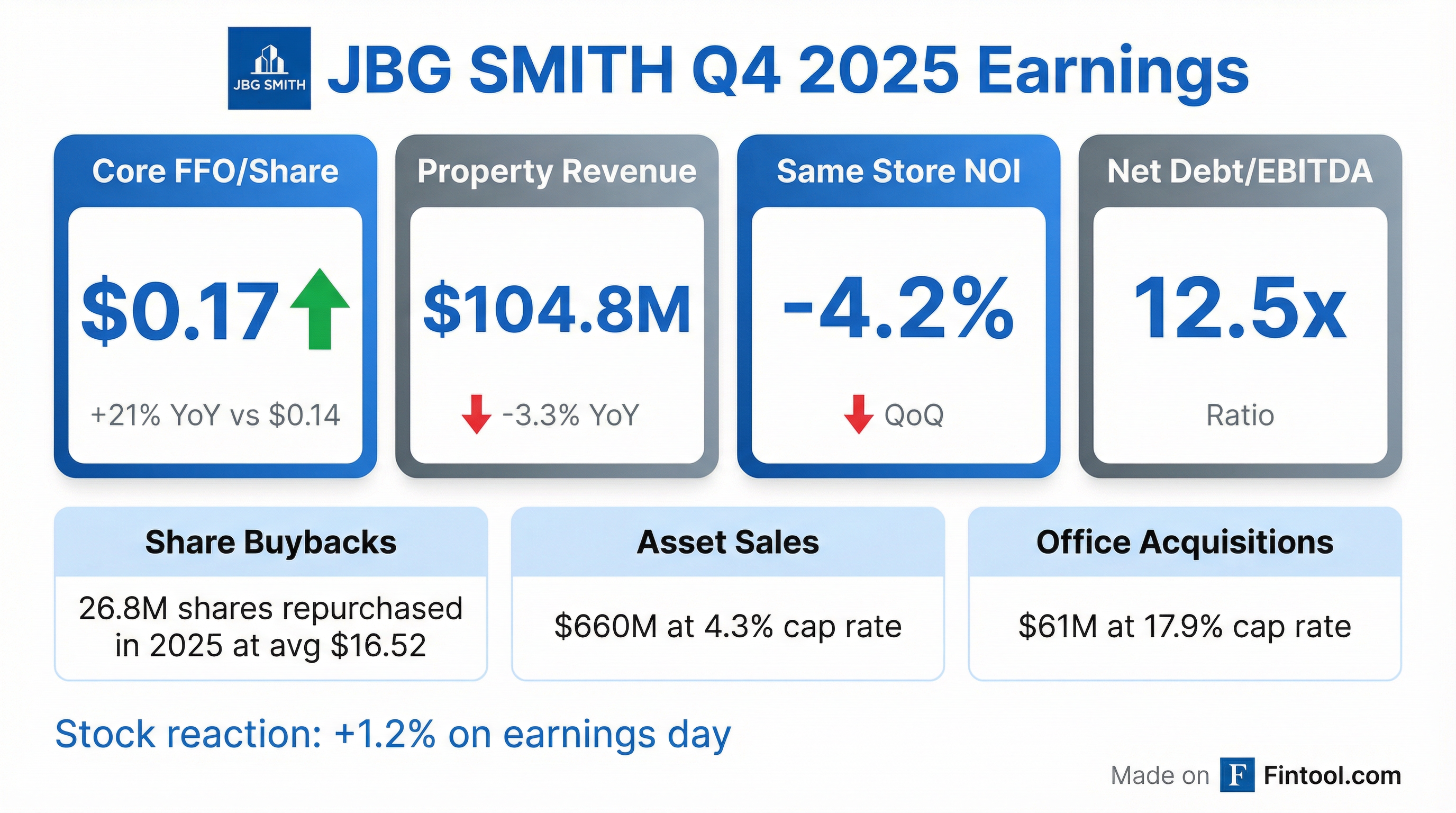
JBG SMITH Properties (JBGS) reported Q4 2025 results that highlight the dual nature of its transformation story: operating metrics remain under pressure from DC's federal workforce cuts, but aggressive capital recycling and share buybacks are reshaping the per-share math. Core FFO per share rose 21% YoY to $0.17, even as absolute Core FFO declined 15% to $9.9M and Same Store NOI fell 4.2% quarter-over-quarter.
The stock traded up approximately 1.2% following the release, closing at $15.98.
Did JBG SMITH Beat Earnings?
The per-share story is positive, but the operating fundamentals remain challenged.
The divergence between absolute and per-share metrics tells the story: JBGS repurchased 26.8M shares in 2025 at an average price of $16.52, reducing the diluted share count from 84.6M to 59.6M (down 30%).
Full Year 2025:
 Ask Fintool AI Agent
What's Happening With the Operating Portfolio?
Multifamily: Pressure in DC, Stabilization in Virginia
The multifamily portfolio ended Q4 at 84.7% leased and 82.7% occupied, down from 89.1% and 87.2% in Q3 2025. The weakness is concentrated in Washington DC proper, which absorbed the brunt of federal workforce reductions.
Key multifamily metrics:
- Same Store effective rents decreased 8.1% for new leases
- Renewal rents increased 3.4% with a 53.4% renewal rate
- Same Store NOI decreased 5.1% QoQ and 2.4% YoY
The DC metro area shed 48,500 jobs from November 2024 to November 2025, with federal government accounting for 52,400 job losses. However, November saw losses "taper significantly" as bipartisan appropriations bills restored funding for health and science agencies.
Office: Defense-Tech Driving National Landing
The commercial portfolio was 77.5% leased and 75.1% occupied, essentially flat quarter-over-quarter. But the composition of leasing activity is notable:
- 90% of Q4 leasing and 93% of 2025 leasing was with defense and technology tenants
- 723,000 SF of office leases signed in 2025 with 4.1-year average lease term
- SCIF (Sensitive Compartmented Information Facility) demand remains particularly strong
Management noted that "the tide is turning for office in Northern Virginia" with absorption turning positive in 2025 for the first time since 2019.
View the full Q4 2025 earnings transcript
What Changed This Quarter?
Capital Allocation: Selling Apartments, Buying Offices
JBG SMITH's strategy of selling low-cap-rate multifamily and acquiring distressed office assets continued in Q4:
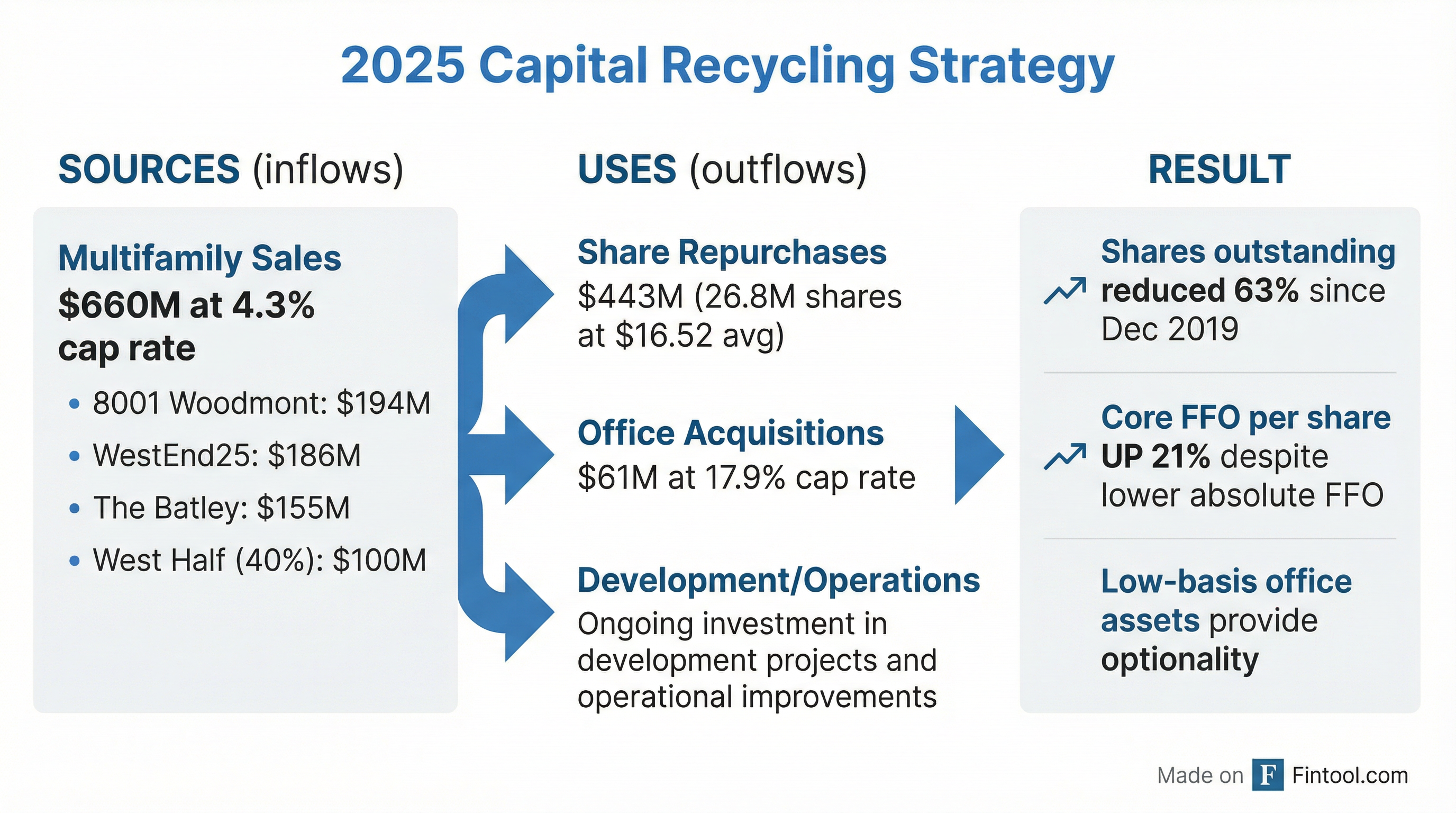
2025 Dispositions ($660.3M at 4.3% weighted average cap rate):
- 8001 Woodmont (Bethesda multifamily): $194.0M
- WestEnd25 (DC West End multifamily): $186.0M
- The Batley (Union Market multifamily): $155.0M
- West Half 40% interest (Ballpark multifamily): $100.0M
2025 Office Acquisitions ($61.2M at 17.9% cap rate, $87 PSF):
- Tysons Dulles Plaza: $42.3M for 491,500 SF
- Dulles View (60% JV): $18.9M at share for 212,600 SF
The math is compelling: selling at 4.3% cap rates and buying at 17.9% creates significant arbitrage, though the office assets carry more risk.
Subsequent Events:
- Sold Potomac Yard Landbay H land parcel for $50.7M (February 2026)
- Extended $200M Tranche A-1 Term Loan maturity to January 2027
Ask Fintool AI AgentHow Did the Stock React?
JBGS shares traded up approximately 1.2% on earnings day, closing at $15.98. The muted reaction suggests the market is still weighing:
Positives:
- Core FFO per share growth despite headwinds
- Defense-tech leasing momentum in National Landing
- Disciplined capital recycling generating attractive spreads
- Federal workforce losses appear to be tapering
Concerns:
- Elevated leverage at 12.5x Net Debt/Adjusted EBITDA
- Same Store NOI declining 4-5%
- Multifamily occupancy weakness in DC
- Only 84.7% of debt fixed/hedged
The stock trades at $15.98 versus management's implied confidence in NAV (they've repurchased $1.6B of stock at an average of $18.77 per share).
What Did Management Guide?
No specific financial guidance was provided, but management offered qualitative outlook:
On leverage trajectory:
"In the near term, we expect our leverage will moderate through additional income from the stabilization of these newly constructed multifamily assets (The Grace, Reva, The Zoe, and Valen) and additional commercial revenue from our signed but not yet commenced leases."
On the federal workforce outlook:
"The passage of these bills and the provisions that come with them suggests that the largest of the cuts – both budget and workforce – are likely behind us particularly as we enter a contested midterm election cycle."
On defense spending:
"The defense budget (already $1 trillion in FY2025 with reconciliation) grew as part of the FY2026 appropriations and the FY2027 proposed budget is $1.5 trillion."
Stabilization Timeline for Under-Construction Assets:
- The Zoe and Valen (775 units total, completed in 2025): 42.6% leased at year-end, expected to generate $21.1M annualized NOI when stabilized
- The Grace, Reva, The Zoe, and Valen were 63.2% leased on average as of year-end
Development Pipeline: Entitled 2.2 million SF of estimated potential development density in National Landing in 2025, including approximately 870 mid-rise multifamily units and approximately 250 townhomes across multiple sites.
Key KPIs to Watch
Balance Sheet and Liquidity
The non-recourse, asset-level financing strategy provides downside protection, though the company notes floating rate exposure is tied to the revolving credit facility and assets where "the business plan warrants preserving flexibility."
Forward Catalysts
Near-term (1-2 quarters):
- Stabilization progress on The Zoe, Valen, The Grace, and Reva multifamily assets
- Additional office leasing in National Landing (strong SCIF demand)
- Continued asset recycling and potential share repurchases
Medium-term (2-4 quarters):
- Federal budget clarity post-midterm elections
- Defense/intelligence spending flow-through to Northern Virginia
- Leverage reduction as NOI grows from stabilized assets
Risks:
- Further federal workforce reductions beyond current expectations
- Interest rate impact on floating rate debt (15.3% of total)
- Multifamily supply in DC metro (though starts have slowed significantly)
Ask Fintool AI AgentThe Bottom Line
JBG SMITH's Q4 2025 results showcase a company in transformation: the DC metro area's federal workforce disruption is pressuring operating fundamentals, but management's aggressive capital recycling is positioning the portfolio for eventual recovery. The 21% growth in Core FFO per share—despite a 15% decline in absolute Core FFO—demonstrates the power of buying back shares at a discount to NAV.
The key question for investors: Is the defense-tech demand in National Landing strong enough to offset broader DC weakness? With 90%+ of leasing coming from defense and technology tenants and absorption turning positive for the first time since 2019, there are early signs the thesis is working.
At 12.5x Net Debt/EBITDA, the balance sheet remains stretched, but management expects leverage to moderate as newly delivered multifamily assets stabilize. The stock's 4.1% dividend yield and significant discount to management's implied NAV provide margin of safety for patient investors willing to bet on the DC recovery story.
This analysis was generated by Fintool AI Agent based on JBG SMITH's Q4 2025 earnings release and 8-K filing dated February 17, 2026.
View Full 8-K Filing | Company Research | Prior Quarter Earnings